Hospitals are under constant pressure to improve patient outcomes, reduce staff burden, and deliver more connected care experiences. The Connected Care Room is an emerging model that brings together virtual care, patient engagement, hospital interoperability, and workflow automation to create a smarter patient environment. In this final article of our Connected Care series, we explore how healthcare organizations can bring these capabilities together and how Oneview helps make that vision a reality.
Over this blog series, we’ve explored the five capabilities that make up the Connected Care Room: the ability to Monitor, Anticipate, Orchestrate, Connect, and Personalize care. In this final article, we’ll look at how healthcare organizations can bring these capabilities together and how Oneview helps hospitals build the Connected Care Room today while preparing for what’s next.
What Is a Connected Care Room?
A Connected Care Room is more than a collection of technologies. It is a model for delivering care where information, workflows, people, and intelligence work together to support patients and caregivers.
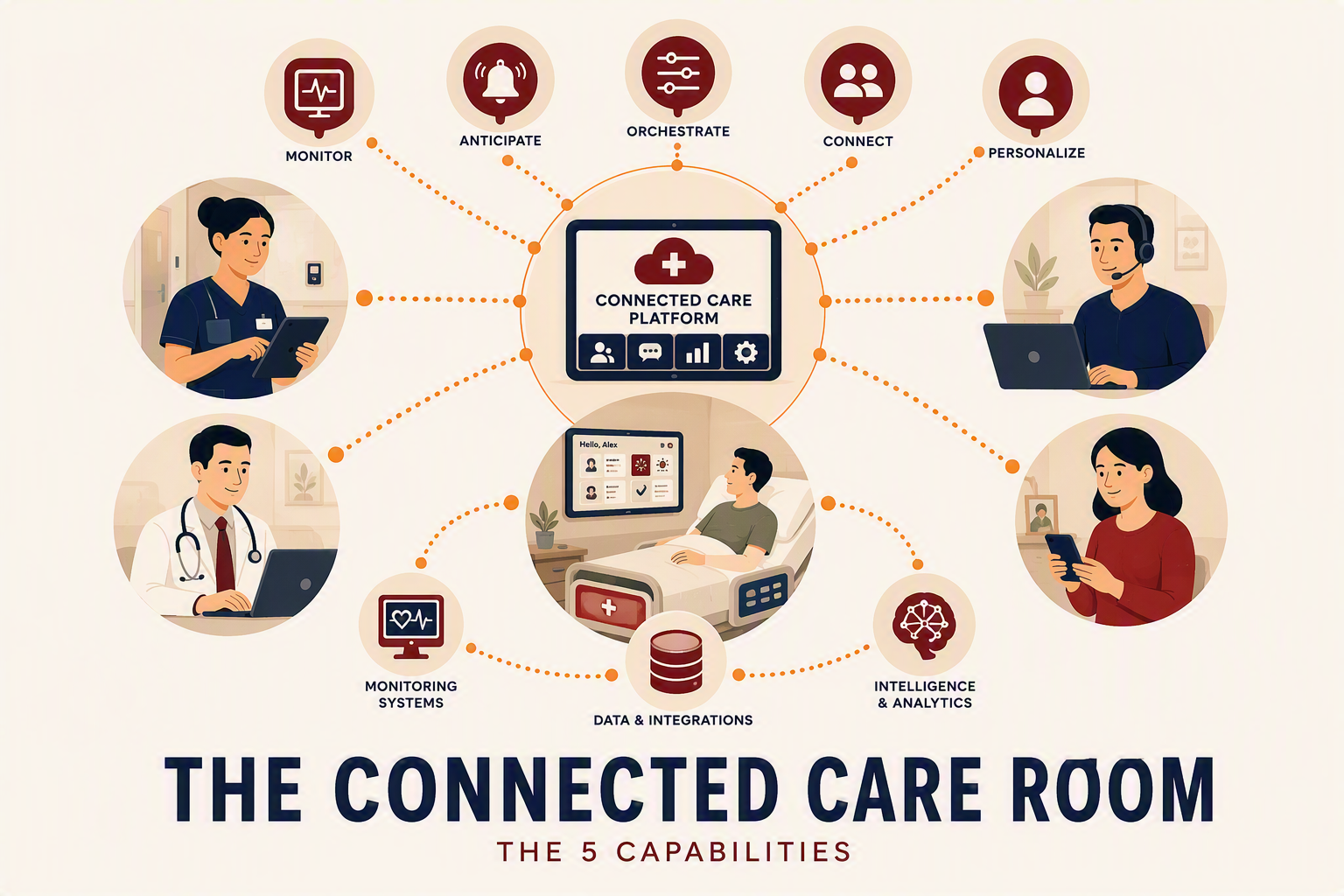
Over the last five posts, I’ve tried to describe what a patient room could be if it carried more of the load we currently ask nurses to hold in their heads. We started with Monitor ,giving the room senses, so awareness of a patient’s condition, needs, and care process is shared by the environment rather than elicited at the bedside. Anticipate turned that awareness into foresight: credible signal, not noise or silence, surfaced early enough to act on. Orchestrate moved work to the right person at the right time, so nurses stop being the manual switchboard for every task on the unit. Connect removed the constraint that you have to be in the room to take part in care, bringing families and remote clinicians into the same live picture. And Personalize made that shared picture personal – care that adapts to each patient’s language, abilities, and stage of recovery.
The Five Capabilities Behind the Connected Care Room
Across all five, the argument was the same. None of this is really about the technology. It’s about restoring to inpatient care the things that get lost at scale – attention, foresight, coordination, connection, and the human act of treating each patient as an individual – and extending the reach of our best caregivers to every patient, in every room, at every hour.
Which brings us to the question every leader reading this series has been asking: how do you actually get there?
Moving from a collection of disconnected point solutions to a room that monitors, anticipates, orchestrates, connects, and personalises as one is a question about platforms, not features. So in this final post I want to step back from the capabilities and be specific about how Oneview – together with our partners – helps you build the Connected Care Room. Some of what follows is available today or coming soon. Some of it is where we believe the room is heading. I’ve tried to be clear about which is which.
How Oneview Helps Hospitals Build a Connected Care Room
Monitor
Today, Oneview transforms the patient room technology already at the bedside into a source of continuous awareness. Our Virtual Care API enables virtual sitter and observation vendors to use the patient television as the bedside endpoint, observing patients while a persistent safety banner makes clear that monitoring is taking place. Ovie Console continuously watches patient engagement, requests, feedback, and service-recovery signals, giving care teams real-time visibility of who may need attention before a situation escalates. Mobility status flows to staff at the point of care through our Digital Whiteboard and Digital Door Sign.
We see this as going to ambient monitoring and computer vision that can assess mobility and functional status without manual observation, generate the associated documentation automatically, and because meals ordered through Oneview already carry full nutritional detail, even estimate and document how much of each meal a patient has actually eaten.
Anticipate
A Connected Care Room should not simply react to events. It should help care teams recognize opportunities for intervention earlier.
Today, our virtual care partners use computer vision to anticipate risk – a high-falls-risk patient moving to the edge of the bed can trigger an audio and visual prompt in the room, encouraging them to wait for help. Ovie helps identify emerging dissatisfaction from behavioural signals – low engagement, repeated unresolved requests, negative feedback – and surfaces them in Ovie Console for proactive rounding.
Looking further out, the same approach could flag the quiet precursors of a delayed discharge – transport not arranged, education incomplete, a consult still outstanding – and combine signals from monitoring vendors, computer vision, and ambient sensing to surface emerging clinical risk hours earlier, with fewer alarms rather than more.
Orchestrate
Oneview already enables patients to request services directly from the TV or bedside tablet, helping route each request to the team best positioned to fulfil the need rather than solely relying on nurses as the coordination hub. Ovie supports intelligent escalation based on request type and urgency
In time, that routing becomes dynamic: a discharge-education need connected to a virtual nurse, a language barrier triggering interpreter support, a transport concern surfaced straight to case management – with Oneview providing the patient-facing engagement layer and the workflow integrations that let those teams coordinate around a common view of the patient.
Connect
The Connected Care Room extends care beyond the four walls of the patient room.
Our Virtual Care API turns the patient television into a shared endpoint for virtual nursing admissions, discharge education, and family participation, so taking part in care no longer requires being in the room. The Digital Whiteboard keeps patients, families, and care teams stay aligned around a common, EHR-driven source of information.
As this expands, we see the whiteboard becoming a dynamic contextual pane that adapts to the people in the room: presenting an assessment workflow and capturing a voice-led pain assessment for a nurse, then shifting context to call up images or trend data by voice when a physician walks in.
Personalise
Personalization is what transforms a smart room into a better care experience.
Today, the Oneview TV and tablet adapt to each patient, updating with preferred language, adjustable text, and simplified interfaces. Education is personalized through EHR integration, so patients receive information relevant to their condition and recovery. Through the Meal Ordering Application, patients order from personalized, clinically appropriate menus.
Where we’re heading is conversational: patients engaging with Ovie in natural language, and in their own language, adapted to their health literacy – Ovie acting as a personal guide that answers questions, supports teach-back, and surfaces knowledge gaps so care teams can follow up where it matters most.
Why Interoperability Matters
If there’s one idea, I hope this series leaves you with, it’s this: the Connected Care Room is a capability model, not a vendor model.
No single company delivers every capability required. Success depends on the ability of EHR systems, virtual care platforms, monitoring technologies, AI solutions, and patient engagement platforms to work together effectively.
Hospital interoperability is not simply a technical requirement. It is the foundation that allows Connected Care Rooms to scale and evolve over time.
Isolated point solutions are the trap. Interoperability is the strategy. Open APIs matter more than proprietary experiences because healthcare organizations need the flexibility to adopt new capabilities as the market evolves. Oneview’s Virtual Care API reflects that philosophy by enabling customers to connect partner solutions to existing patient-facing infrastructure.
The Road Ahead
A useful way to think about the Connected Care Room journey is:
Today: Connect people to information.
Next: Connect workflows to context.
Future: Connect intelligence to care.
Always: Keep humans in the loop.
Clinical decisions stay with clinicians, and human relationships stay at the centre of care. The purpose of technology is not to replace caregivers. It’s to extend the reach of your caregivers, so that more patients receive the benefits of great care, consistently.
See the Connected Care Room in Action
The Connected Care Room isn’t a distant vision. Many of its building blocks are already operating in hospitals today, while others are rapidly approaching practical implementation.
If this series has prompted you to ask how your rooms could monitor, anticipate, orchestrate, connect, and personalise as one, the best next step is to see it action.
Reach out and let’s talk about how Oneview and our partners can help you build the Connected Care Room, starting with what you can do now and building toward what comes next.