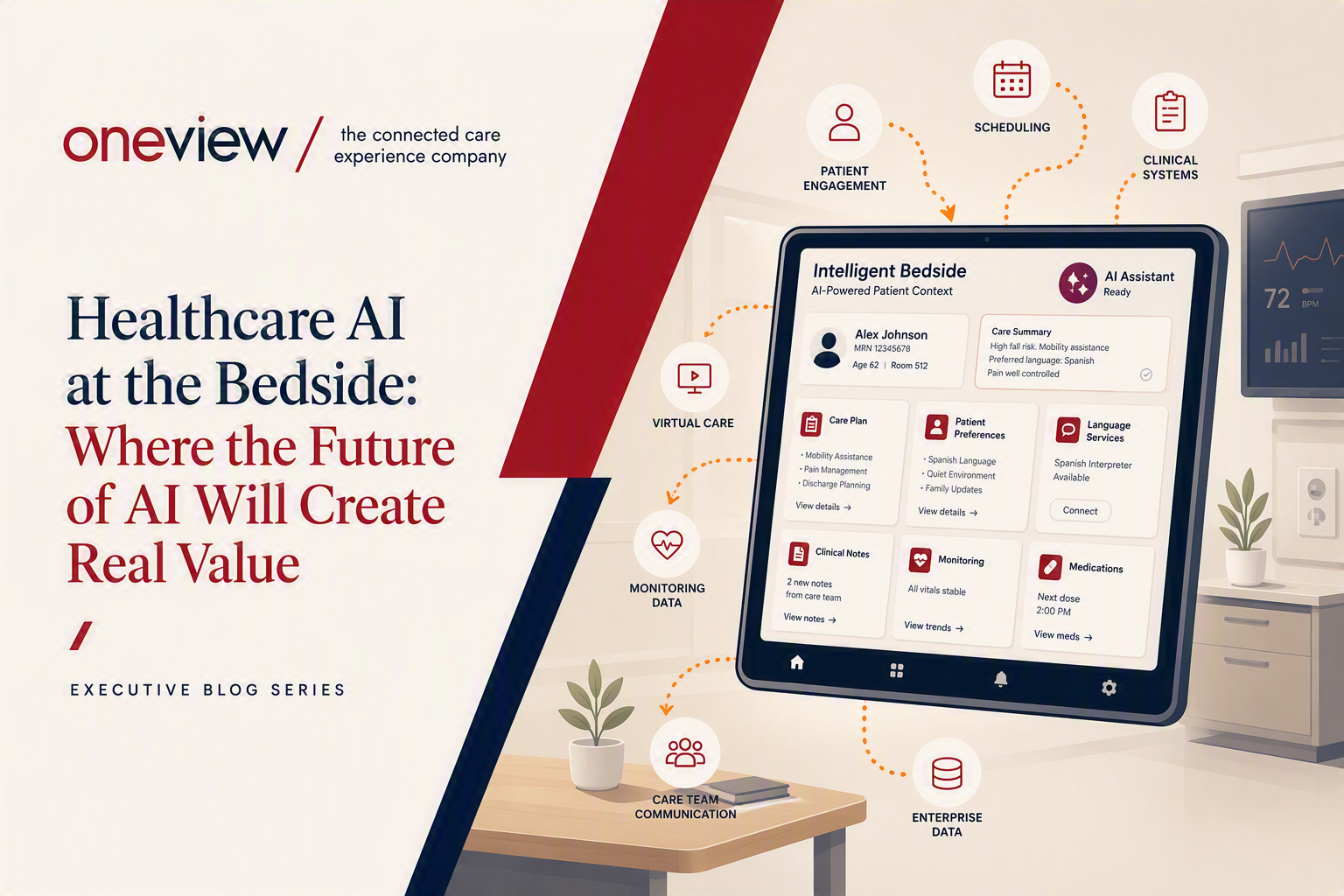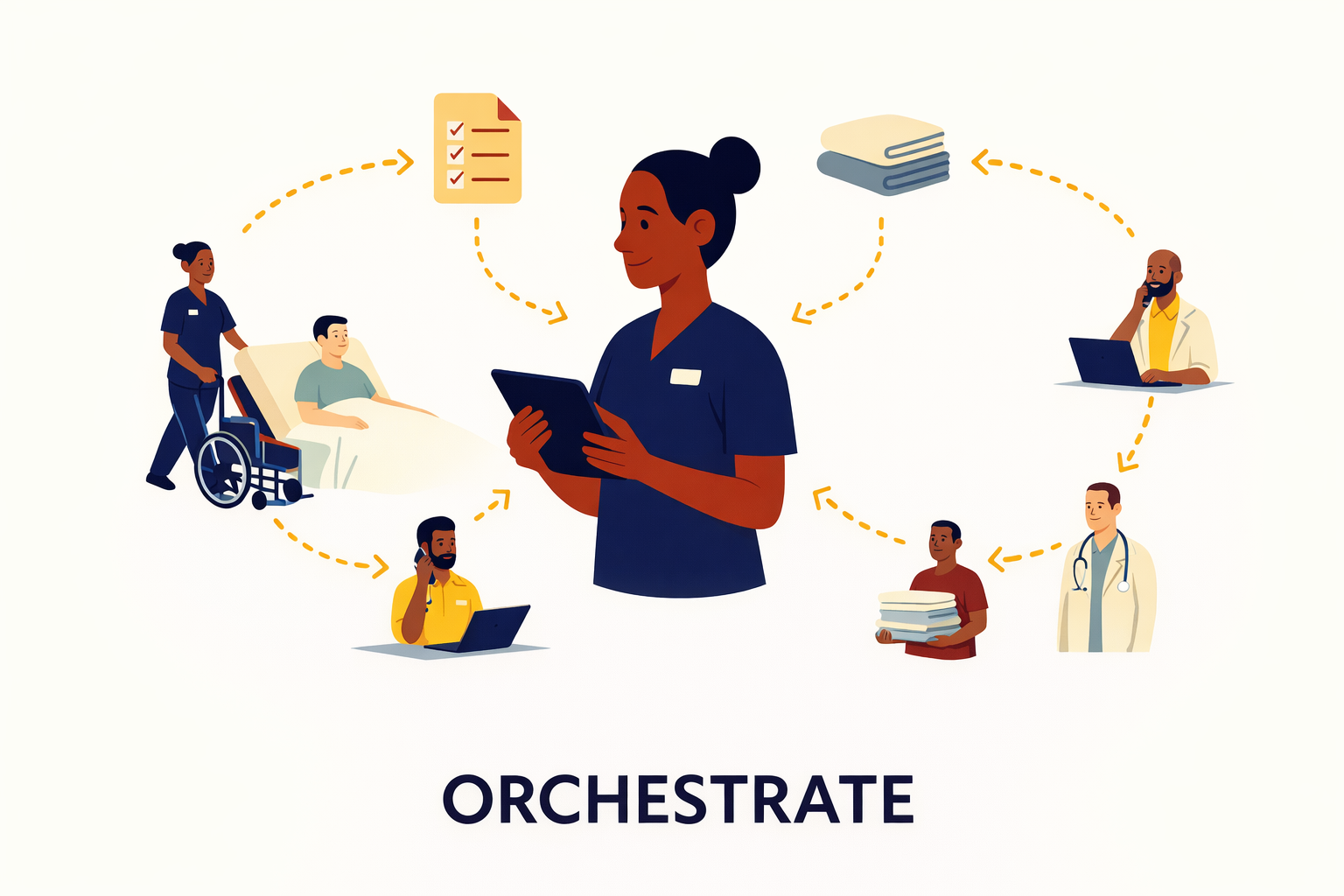
The earlier posts in this series explored Monitor and Anticipate, and now we shift focus on the third capability, Orchestrate – the part of the model that makes awareness and foresight actionable. Connected Care Room orchestration is what keeps care moving without requiring nurses to function as the default coordination layer for everything the system should be routing, tracking, and progressing.
Care orchestration in a Connected Care Room is the system-driven coordination of clinical and non-clinical workflows, like routing tasks to the right person at the right time, so nurses aren’t forced to be the manual switchboard for the unit.
What “Orchestrate” Means (and Why It Matters)
The Connected Care Room is a capability model built around five functions: Monitor, Anticipate, Orchestrate, Connect, and Personalise. Together they describe what a patient room must do to enable proactive, coordinated care. Orchestrate is the capability that ensures care keeps moving without nurses acting as the default coordination layer for work the system should own.
Enhancing Patient Care through the Connected Care Room
Orchestrate is the capability that ensures care keeps moving without nurses acting as the default coordination layer for work the system should own. On a busy med-surg unit, coordination is constant and largely invisible: discharge tasks accumulate, call bells interrupt, admissions arrive at shift change, and the nurse becomes the human router by diagnosing requests, finding the right resource, and stitching together handoffs.
Why Nurses Become the Default Coordination Layer
Understanding the Role of the Connected Care Room in Patient Outcomes
This work falls to nurses because nurses are the backbone of acute care. They are always present, always reachable, and always accountable. For as long as the system has had no other mechanism to route coordination work, nurses have absorbed it. That is not a criticism of how units operate. It is a description of what happens when the environment asks more of people than it was designed to handle. So when there’s no reliable orchestration layer, coordination work naturally collapses onto them.
Orchestrating Admission Workflows with Virtual Nursing
When a patient arrives on a med-surg unit, the admitting nurse is responsible for completing a structured assessment that covers clinical history, medications, social determinants of health, and patient education needs. This is time-consuming, documentation-heavy work and it often lands at the worst moments: shift change, high census, late at night.
Virtual nursing changes this, but only when orchestration is intentional. A virtual nurse, operating remotely with access to the patient via video and to the EHR in real time, can own the structured components of an admission (med rec, social history, education needs, documentation), while the bedside nurse focuses on the physical assessment and in-room tasks. That division of labor is not just “adding a virtual nurse.” It’s Connected Care Room orchestration: clear routing, clear role boundaries, and clear handoffs.
Evidence is increasingly aligning with what frontline teams already suspect: virtual nursing can improve documentation completeness and support admissions and discharges—but results depend on how well the work is defined and routed. A 2025 observational study from the University of North Carolina found that virtual nurses completed 80.2% of admission documentation compared to 58.8% by bedside nurses and did so more thoroughly. A large 2025 survey of 880 nurses across ten US states, published in JAMA Network Open, found that admission and discharge activities were among the top three uses of virtual nurses in practice. The same study found that where role boundaries and workflow routing were poorly defined, virtual nursing yielded mixed results on workload reduction.
That finding is worth sitting with. Virtual nursing is not a workload solution by default. It becomes one when the orchestration layer is intentional: when the system clearly defines which tasks route to the virtual nurse, which remain with the bedside nurse, and how handoffs between them are managed. The technology enables the model. The workflow design makes it work.
Rethinking Call Bell Routing and Workflow Efficiency
The call bell is the oldest coordination mechanism in hospital care and one of the most inefficient. Every request, regardless of its nature, arrives at the same place: the nurse. A patient who needs pain reassessment and a patient who wants their window blind adjusted both activate the same system and reach the same person.
In 2023, McKinsey surveyed nurses across 69 distinct activities to understand how nursing time is actually spent. Nurses consistently reported wanting to spend less time on documentation, hunting and gathering, and support activities, and more time on direct patient care. McKinsey estimated that between 10% and 20% of shift time is spent on activities that technology could optimise, and a further 5% to 10% on tasks that could be delegated to support staff. The call bell sits at the centre of both problems. It routes non-clinical requests to a clinician, and it does so through a mechanism that requires the nurse to stop, respond, and redirect before any useful work happens.
The consequence is not just inefficiency. Every non-clinical call bell is an interruption to clinical work. The interruption cost is real, and it compounds across a shift. A Connected Care Room changes the routing model:
- Some needs can be surfaced before they become call bell activations, using ambient context (e.g., environment outside comfortable parameters, prolonged stillness).
- When requests do arrive, they can be routed at the point of activation rather than defaulting to the nurse – blanket requests to support staff, pain assessment to the nurse, and so on – based on unit workflows and roles.
The effect is not only operational. Patients who receive a faster response to a non-clinical need, from the right person, feel heard. Nurses who are interrupted less by requests outside their scope have more attention for the patients who need them most.
The point isn’t to remove nurses from care. It’s to remove them from being the human switchboard: route non-clinical work to the right role – so clinical attention stays where it’s needed.
Fixing Discharge Delays Through System-Based Coordination
Discharge is where the coordination failure is most visible and most costly. A patient who is clinically ready to leave may remain in hospital for hours, sometimes longer, while tasks that could have been tracked and progressed across the admission are instead assembled under pressure at the end.
A 2024 scoping review synthesising more than two decades of evidence across 700 studies concluded that the primary cause of delayed hospital discharge is inadequate internal coordination, not insufficient bed capacity. A separate 2025 narrative review drawing on 20 peer-reviewed studies found that structured discharge coordination reduced length of stay by half a day to a full day, improved patient throughput, and reduced readmission rates. The mechanism is straightforward: when someone or something is accountable for tracking and progressing every discharge task in real time, fewer tasks fall through the gaps.
Today that accountability sits with the bedside nurse by default. They are tracking pending tests, chasing results, completing education, coordinating with social work, confirming transport, and managing family communication alongside everything else on their patient load. Each of those tasks involves a different person, a different system, and a different timeline. None of it is automatically visible to anyone else.
The opportunity in a Connected Care Room is to make discharge a system-owned workflow rather than a nurse-assembled one
- A live view of discharge tasks
- Status visibility and ownership clarity
- Progressive triggering across the admission (not compressed into the final hours)
- Delays surfaced early enough to act
The Impact: From Firefighting Back to Caring
Across all three workflows, the pattern is the same. Nurses are carrying coordination work that the system does not know how to do without them.
The Connected Care Room does not remove nurses from care. It removes them from manual coordination burden. When admission work is distributedintentially, nurses can direct their attention to what requires clinical skill, human presence, and professional judgment.
That is not a marginal efficiency gain. It is the difference between a shift spent firefighting and a shift spent caring.
What Comes Next: Connect
Orchestrate ensures the system moves work to the right place at the right time. But care is not only a set of tasks. It is also a set of relationships: between patients and their care teams, between families and the people looking after their loved ones, between bedside nurses and colleagues who may be working remotely. The next post in this series explores Connect, the fourth capability of the Connected Care Room, and what it means to bring those relationships into the same shared, real-time context that makes coordinated care possible.