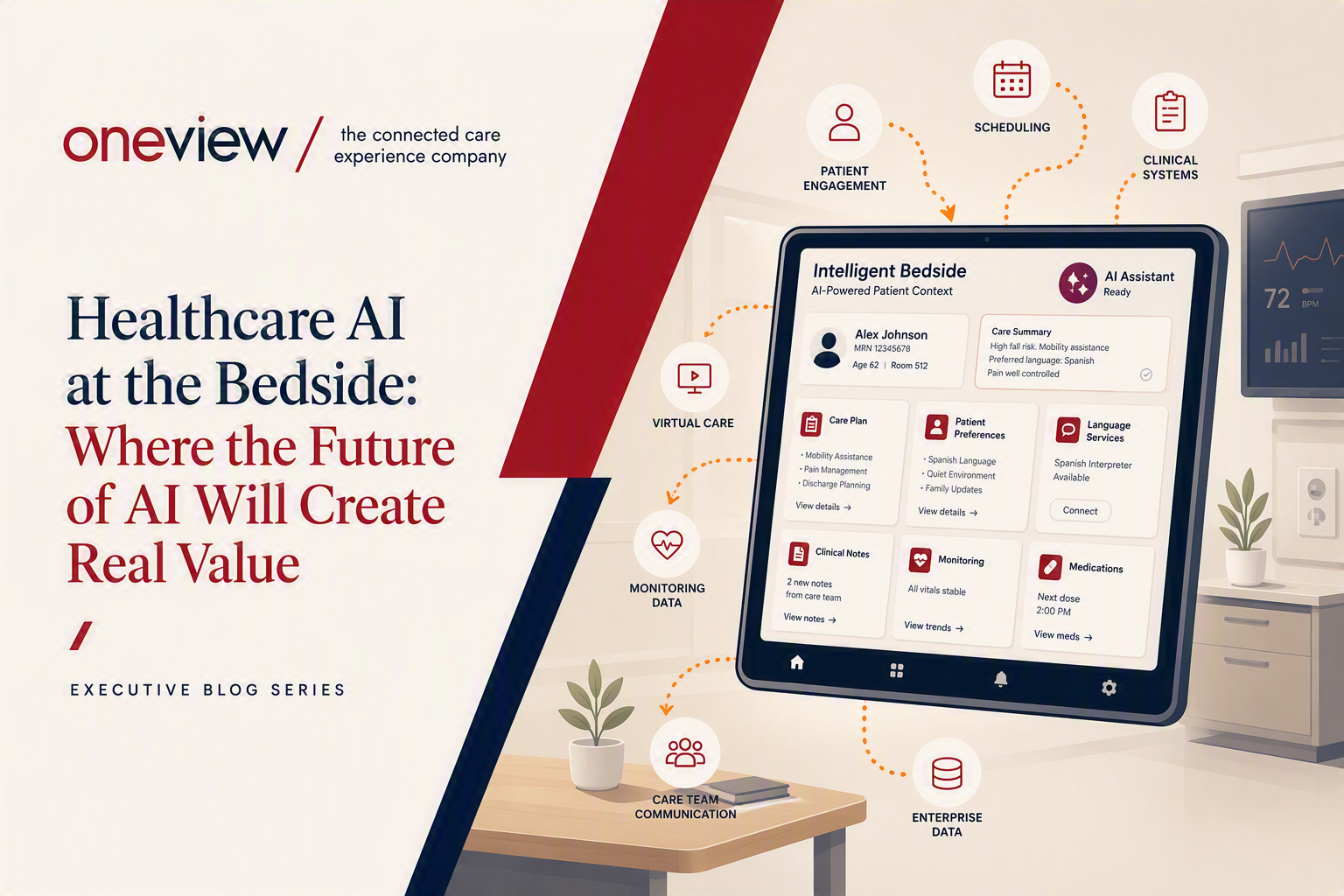
Healthcare AI at the Bedside: Where the Future of AI Will Create Real Value
Much of the discussion around AI focuses on models. Which model is more capable? More accurate? More powerful?
Those questions matter. But as AI becomes increasingly accessible, competitive advantage is likely to shift from models to implementation.
Healthcare is a perfect example. The challenge isn’t access to AI. It’s integrating AI into clinical workflows in ways that are trusted, adopted, and capable of delivering measurable outcomes.
That’s why I believe the future of healthcare AI will be won at the bedside.
The bedside is where patients, clinicians, workflows, and information come together. As healthcare organizations invest in connected patient rooms, virtual care, and care orchestration, it is becoming the environment where AI can create the greatest impact.
Why Context Matters More Than Capability
The healthcare industry often evaluates technology based on features and functionality. AI, however, is likely to be judged by something far more practical: whether it helps clinicians and patients in the moments that matter most.
The bedside is where healthcare becomes real. It is where patients, clinicians, caregivers, workflows, communication, and information converge. It is also where many of healthcare’s most persistent inefficiencies become visible.
This makes the bedside a uniquely valuable environment for AI.
Not because it is the most technologically advanced area of a hospital, but because it provides context. Context is what transforms AI from a general-purpose technology into a practical tool for supporting care delivery.
The opportunity is not simply to make AI smarter. The opportunity is to make healthcare workflows simpler, faster, and more connected. Organizations focused on healthcare digital transformation could benefit from considering how AI is integrated into care delivery, not simply how it is deployed.
The Patient Room Is Becoming an AI-Enabled Environment
The modern patient room is already evolving beyond its traditional role as a destination where care happens. Increasingly, it is becoming a connected environment where patient engagement, clinical communication, virtual care, operational workflows, and digital services come together.
This evolution creates a natural foundation for AI. As organizations invest in connected care rooms, new opportunities emerge for AI-powered experiences that support both patients and clinicians. Voice-enabled interactions can streamline communication. Intelligent assistants can help surface relevant information. Virtual care workflows can become more seamless. Routine requests can be automated and routed more efficiently.
These capabilities become significantly more impactful when they are embedded into care delivery rather than introduced as standalone technologies.
This aligns closely with the broader shift toward care orchestration in healthcare, where organizations focus less on individual technologies and more on how information, people, and workflows work together to create capacity.
From Artificial Intelligence to Practical Intelligence
One of the biggest misconceptions surrounding healthcare AI is that success will be determined primarily by model performance.
In reality, trust may matter even more than intelligence.
Healthcare decisions carry significant consequences. Clinicians need confidence that technology supports their work rather than complicates it. Patients need confidence that technology enhances their experience rather than replacing human interaction. Organizations need confidence that solutions deliver measurable outcomes rather than simply generating interest.
The healthcare organizations that succeed with AI will likely be those that focus on implementation, workflow integration, and user adoption as much as they focus on technology itself.
In many ways, healthcare AI is following a familiar pattern. Previous waves of digital transformation showed that technology adoption is rarely about features alone. Success comes from making complex systems feel intuitive, reducing friction, and fitting naturally into existing workflows.
AI will be no different.
Why Healthcare AI Is Really a Capacity Strategy
At its core, the healthcare AI conversation is increasingly becoming a conversation about capacity.
Healthcare organizations are being asked to care for more patients while operating with constrained resources and ongoing workforce shortages. AI has the potential to help address these challenges, not by replacing clinicians, but by helping remove some of the administrative burden and workflow friction that consumes valuable time.
When routine tasks can be streamlined, clinicians gain more time for direct patient care. When communication becomes more efficient, delays can be reduced. When information is surfaced proactively, care teams spend less time searching for answers and more time delivering care.
These benefits are operational in nature, but their impact extends much further.
They contribute to clinician satisfaction. They support patient outcomes. They improve care team coordination. Most importantly, they help create capacity within the healthcare system.
This is why I believe the long-term value of AI in healthcare will not be measured by the sophistication of the model alone. It will be measured by its ability to help health systems deliver care more effectively.
The Future of Healthcare AI Will Be Built Around Care Delivery
As AI continues to mature, the conversation will gradually shift away from models and toward outcomes.
Healthcare leaders will increasingly ask different questions. Not “What can the model do?” but “How does it improve care delivery?” Not “How intelligent is the technology?” but “How effectively does it support patients and clinicians?”
The organizations that create the most value will not necessarily be those developing the most advanced models. They will be those building the environments where AI can be trusted, integrated, and operationalized.
That means creating connected workflows. It means investing in care orchestration. It means designing digital environments that support clinicians rather than distract them.
And increasingly, it means reimagining the bedside as a strategic platform for innovation.
AI is not the destination.
Better care is.
The organizations that learn how to orchestrate people, information, workflows, and technology around the patient will be the ones that define healthcare’s next chapter. And in many cases, that work will begin at the bedside.