From Smart Rooms to Connected Care Rooms: What Patient Rooms Need to do Better
For over 12 years, I’ve been working with hospitals and healthcare systems around the world, putting technology in patient rooms to support better care experiences. From my first month with Oneview back in Jan 2014, when I found myself at UCSF’s new Mission Bay campus in hard hat, steel cap boots, and safety vest as we demoed the Oneview system to over a hundred staff – to the present day, the technology has evolved. What’s surprised me most is how little that evolution has changed the feel of care for most hospitals. We – the industry – are still putting technology on top of a reactive, manual model of care.
Hospitals have plenty of systems, devices, screens, and dashboards. Yet for patients, families, and care teams, the experience of inpatient care is still too often reactive and fragmented.
Think of clinical rounding, where the nurse rounds based on time not based on need. Or non-clinical needs, where a nurse must answer a call bell and then coordinate with other people to ensure the patient’s need is met. Or patient satisfaction, where issues are only detected when a leader asks a patient “how was your care?”.
Patients often find themselves waiting for answers, while families struggle to stay connected to what’s happening. Nurses spend an extraordinary amount of time coordinating across systems and roles just to maintain momentum. That’s not because people don’t care. It’s because too much of care still depends on manual coordination.
Connected care is the real goal
When coordination depends this heavily on people, care doesn’t scale well. It’s inefficient apart from anything else. And people are fallible, especially when they’re under pressure, meaning quality suffers. The more complex care becomes, the more strain it puts on the very people holding it together.
I’ve been using the term “Smart Patient Room” to describe a vision for the hospital patient room. Talking to healthcare system executives at ViVE last week, I realised I was using the wrong language. This isn’t about rooms being dumb or smart. It’s about rethinking care around connection.
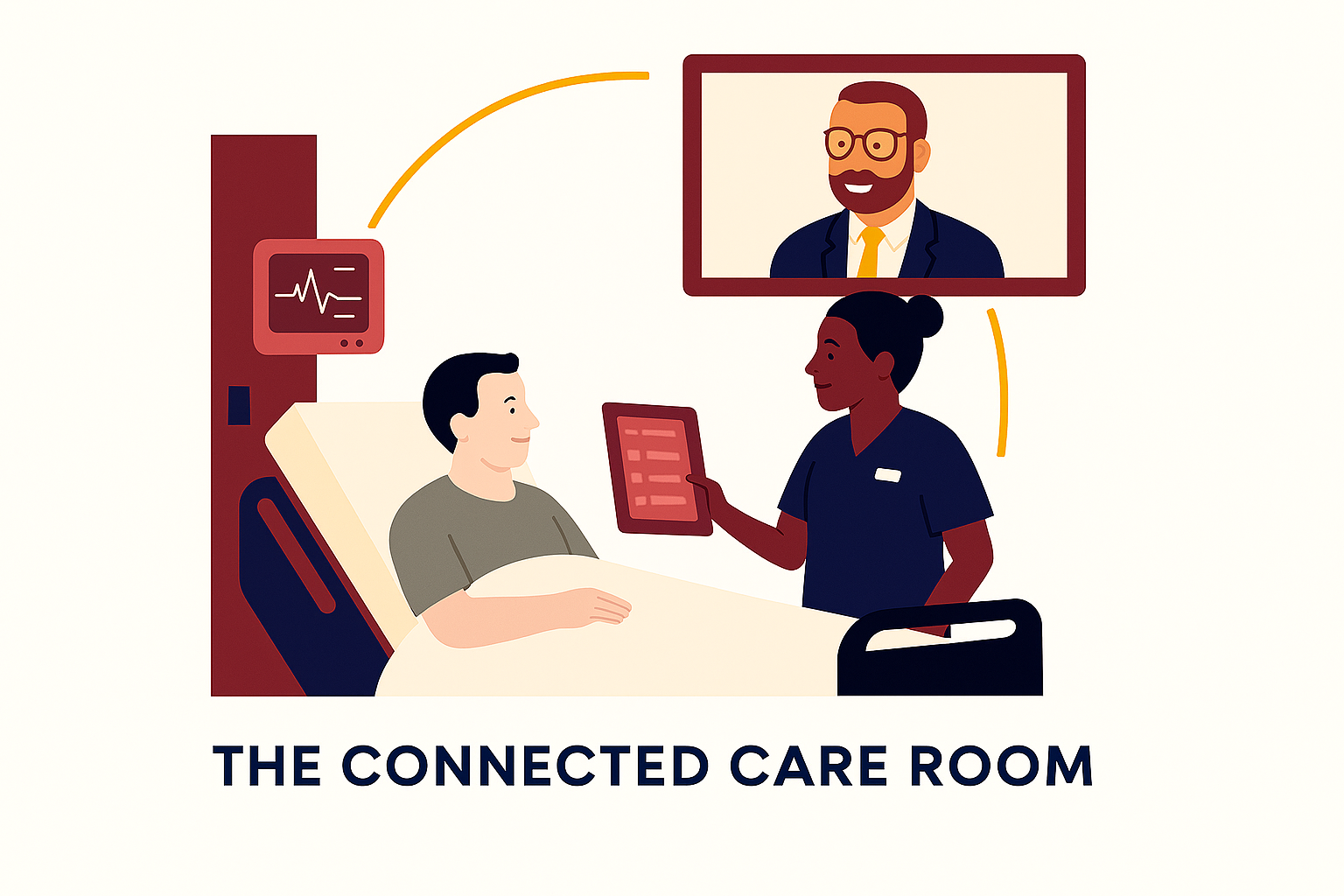
Connected care means patients, families, and care teams can participate in care together, using shared, realtime context, wherever they are. The patient in the bed. The nurse at the nurse station. A virtual nurse in a command centre. A family member in another state.
If those people aren’t aligned around the same understanding of what’s happening and what needs to happen next, care will always feel disjointed – no matter how many systems are installed. Real-time context is key to this. In moments such as a patient at risk of falling moving to leave the bed, a nurse deciding whether something can wait, or a family member trying to understand what’s changed since yesterday.
When that context lives across disconnected systems – the EHR, monitoring devices, notes, and hallway conversations – coordination breaks down. The room is where all of that comes together, or falls apart
The Connected Care Room
So what is the Connected Care Room?
It’s the physical and digital environment where people, context, and workflows come together around the patient. It’s where bedside care meets virtual care. Where families either become true participants or remain passive observers.
Importantly, the Connected Care Room is not any single product or category, and it’s not vendor–specific. Treating it that way is one of the reasons organisations end up with brittle and silo-ed solutions.
Instead, it’s a capability model. It describes what the room must enable, regardless of which technologies are used underneath. It provides a framework that healthcare systems can use to define solutions, and ensure those solutions are complimentary, and connected.
In plain terms, a Connected Care Room does one thing well: it keeps everyone aligned without constant chasing.
A Connected Care Room is a patient–centric care environment that personalizes care and orchestrates workflows across patients, staff, and systems based on continuous contextual awareness – enabling proactive, coordinated care instead of reactive, interrupt–driven work.
The five capabilities that matter
A connected patient room is defined by five capabilities:
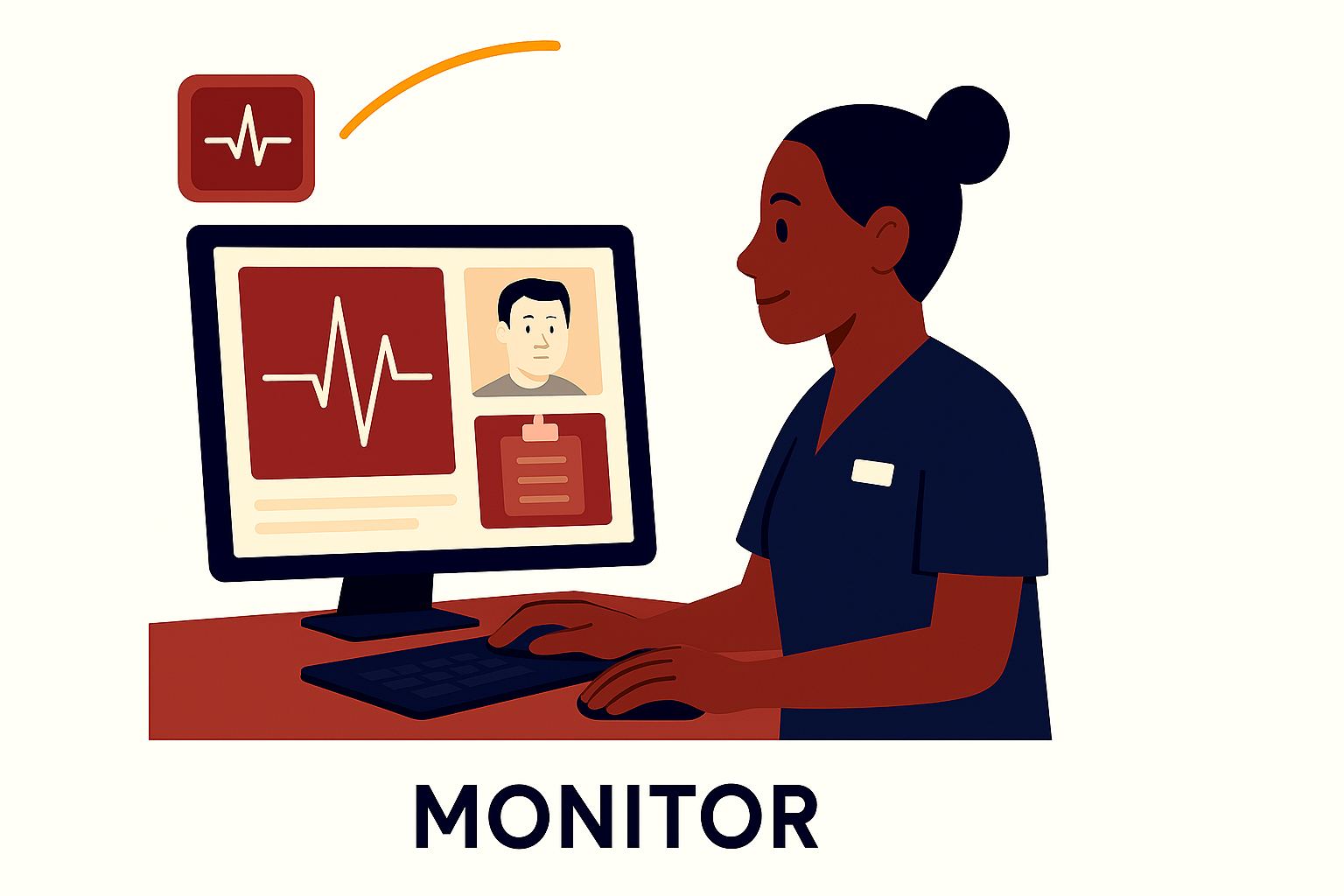
- Monitors
Builds continuous awareness of what’s happening in and around the room, across patient interactions, environment, and workflows – without relying on constant manual checks.
- Anticipates
Surfaces needs, risks, or next steps before issues escalate, complaints are filed, or staff are forced into lastminute firefighting.
- Connects
Enables patients, families, and care teams to participate in care together through shared, real–time context and seamless communication, wherever they are.
- Personalizes
Adapts information, guidance, and interactions to the individual patient’s needs, preferences, and stage of care, rather than forcing everyone through the same generic experience.
- Orchestrates
Coordinates workflows, tasks, and communication across roles and systems so care keeps moving without nurses acting as the default coordination layer.
Why leaders should care
For nursing leaders, connected patient rooms are one of the few levers that genuinely reduce interruption and support nurses working on the care that matters most.
For patient experience leaders, they make it easier for patients and families to feel informed, involved, and respected – without relying on heroics from staff.
For IT and operational leaders, they provide a clearer way to think about coordination, integration, and roadmap decisions, rather than chasing point solutions that solve one problem and create three more.
Most importantly, they give organisations a shared language for what better inpatient care should look like in practice.
This is about today – not just tomorrow
This might feel like a “room of the future” vision not a reality for the present.
But after more than a decade in this space, I know many of these capabilities already deliver value today: better communication, fewer nonclinical interruptions, clearer discharge preparation, more consistent patient experiences. Hospitals that wait for everything to be “ready” tend to stay stuck.
At the same time, this model doesn’t paint organisations into a corner. As ambient sensing, predictive approaches, and new care models mature, the same connected patient room foundation supports them naturally.
Connected care doesn’t require doing everything at once. It requires being clear about what the room needs to do today, and how that foundation can extend over time.
By focusing on the capabilities of the connected patient room, hospitals can:
- Deliver real benefits now
- Make pragmatic, modular investments
- Avoid locking themselves into dead-end architectures
In the posts that follow, I’ll go deeper into each of these capabilities – what’s achievable today, what’s emerging over time, and how organisations can build toward connected care without overengineering or overpromising. While I know that Oneview can help healthcare systems on this journey, this isn’t about our products – I’ll leave that to the very end of the series, when I’ll focus on how we can help.
Looking forward to the conversation this sparks.