Monitor – The Foundation of the Connected Care Room
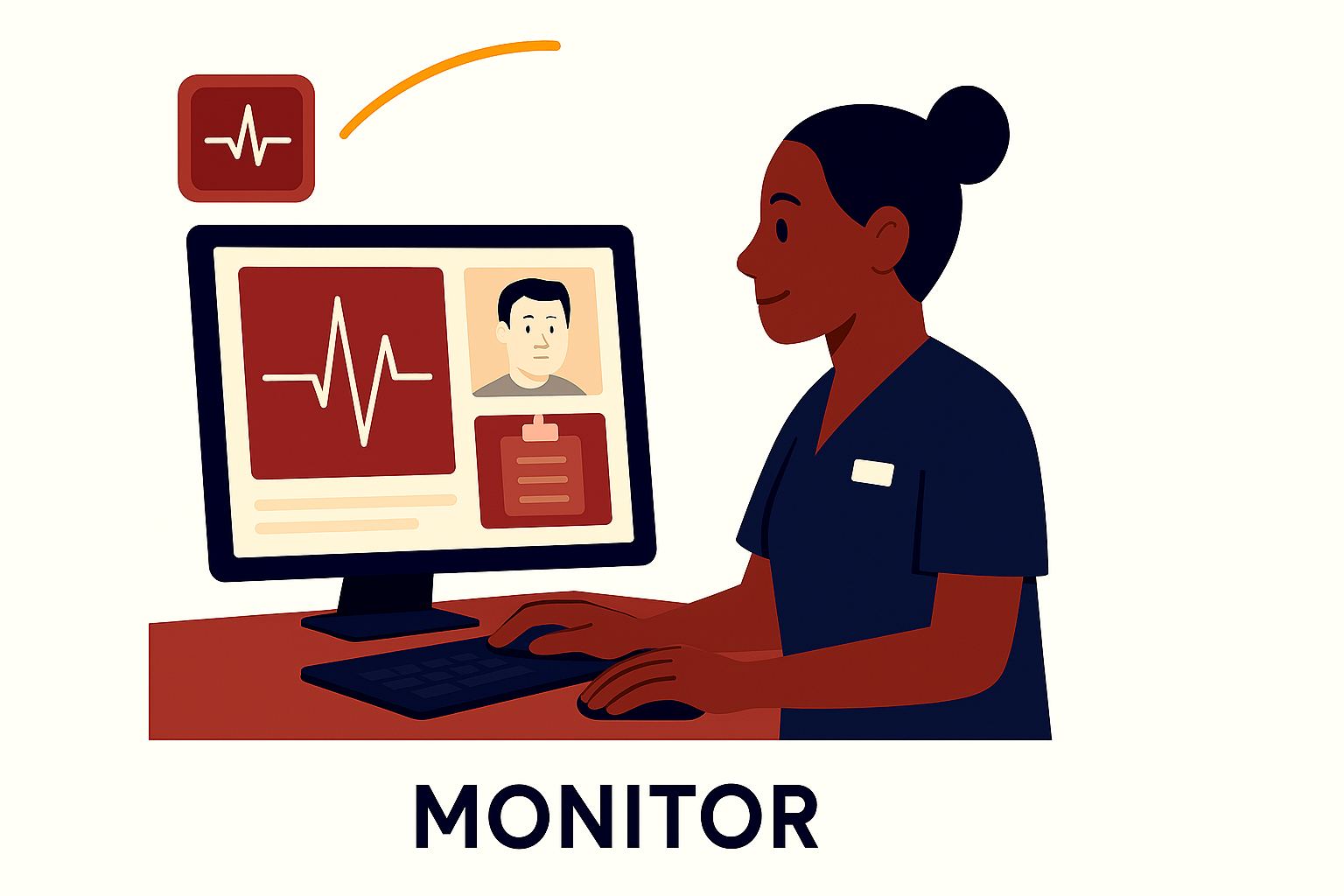
In the previous post, I introduced the Connected Care Room as a capability model built around five core functions: Monitor, Anticipate, Connect, Personalise, and Orchestrate. This post goes deeper on the first – and most foundational – of those: Monitor.
Monitoring matters because care cannot be predictable, proactive, or well-coordinated if the patient room itself is effectively blind. When the room doesn’t reliably surface what’s happening, nurses are forced to carry that burden themselves.
The goal of monitoring in a Connected Care Room is not to add more data or more alerts. It is to build continuous, shared awareness of what’s happening in and around the patient – their condition, their needs, and whether care is unfolding as intended – so nurses don’t have to rely on constant manual checks to stay safe.
At its simplest, monitoring replaces assumption with signal, allowing care to become more predictable.
The Reality of Monitoring Today
Walk a medical surgical floor and you’ll find no shortage of technology. But look at how care teams actually know what’s happening with their patients, and a familiar pattern emerges: nurses checking on patients, on a schedule, filling the gaps left by systems that don’t reliably hold context.
This is not a failure of practice. It is a reflection of professional vigilance.
In most inpatient units today, nurses are the connective tissue between disconnected systems. They check and recheck, constantly breaking their flow of work, because the system gives them no safer alternative. This constant rechecking isn’t just inefficient – it forces nurses to carry continuous cognitive and emotional load, holding risk in their heads because the system cannot.
Patient condition
On most general units, vital signs are still captured every four to six hours. Early warning scores are calculated from those readings, but between checks there is often no continuous signal – only the assumption that no news is good news.
Clinical deterioration rarely respects a schedule. Subtle changes in respiratory rate, heart rate, or mobility can trend for hours before crossing a threshold that triggers attention. By the time the next scheduled check occurs, what could have been a lower acuity intervention may now require escalation – not because warning signs were missed, but because they were never visible.
Continuous monitoring studies on general care units consistently show that deterioration is detectable earlier – sometimes hours earlier – than intermittent observation allows. Nurses already understand this risk. The system simply doesn’t surface it in time.
Patient needs
For many nonclinical needs, the call bell remains the primary signal. That means nurses are alerted only once a need has already escalated to interruption.
This is not because nurses aren’t anticipating needs – it’s because the room provides little visibility into what’s building up between interactions. Anxiety, discomfort, unmet mobility needs, or uncertainty about what’s coming next all accumulate silently until they become audible.
Each call bell represents a moment where the system lacked the context to act earlier. And because resolving even simple needs often requires coordination across roles, these interruptions ripple across the care team, fragmenting attention and flow.
Without better signal, teams can only prioritize by schedule, not by need.
Care process
Care processes are often the least visible of all. Is rounding happening as intended? Has mobility been assessed? Are protocols being followed consistently across shifts?
In most hospitals, answers to these questions live in retrospective documentation – incomplete, delayed, or disconnected from real-time care. Nurse leaders trying to understand variation must either observe directly or chase records after the fact.
This invisibility doesn’t reflect lack of effort. It reflects systems that fail to make essential work visible as it happens.
Taken together, the picture is of a care environment that forces nurses to be reactive not by choice, but by necessity. Staff are skilled, committed, and vigilant – but they are carrying a level of situational awareness that should be shared by the room itself.
What the Connected Care Room Changes
The shift is not toward more point solutions. It is toward a care environment that can reliably know what’s happening and share that context with the right people at the right time.
Advances in continuous vital sign monitoring, computer vision, and ambient sensing are making it possible for the room itself to surface meaningful signals – changes in physiology, unsafe movement, unmet needs – without relying on constant manual checks or intrusive alerts.
Care teams already struggle with data overload: too many alarms, too many disconnected systems, too little usable signal. The opportunity is to build continuous awareness across condition, needs, and process, and surface that awareness in ways that support nursing judgment rather than compete with it.
Patient condition
Wireless monitoring now makes continuous vital sign awareness practical beyond the ICU, particularly for higher risk general unit patients.
This shift isn’t just clinical – it’s operational. When early warning signals are tracked continuously, nurses can direct their physical presence where it’s most needed, rather than moving room to room on a fixed schedule regardless of acuity.
Recent studies on medical wards show that continuous wireless vital sign monitoring is associated with reduced ICU transfers and mortality compared with intermittent spot checks, enabling earlier intervention when subtle deterioration emerges.
Patient needs
A Connected Care Room closes the gap between patients and care teams without relying solely on interruption.
By maintaining awareness of how long it’s been since a patient was last checked on, whether they’ve been awake overnight, or whether questions have gone unresolved, the room helps surface emerging needs earlier and more intentionally.
When needs are surfaced to the right role at the right time, care shifts from interruption driven to flow driven. Patients feel seen. Nurses regain control of their attention.
The room doesn’t replace nursing judgment – instead, it supports it with context.
Care process
Continuous visibility into care processes makes essential but often invisible work visible in real time.
When designed well, these systems function as support rather than surveillance – reducing documentation burden, validating effort, and enabling improvement without hindsight. At Ottawa Hospital, an AI driven hand hygiene system using contextual prompts achieved a sustained increase in compliance, with staff describing it as a helpful reminder rather than oversight.
The intent is not to police behaviour, but to ensure critical practices are reliably supported and credited as they occur. Realtime process awareness shifts quality from retrospective audit into live practice.
The Through Line
Across all three domains, the common thread is the same: continuous, connected awareness that shifts vigilance from individuals back into the system.
Today’s nurses are not failing to manage complexity – they are absorbing it. The Connected Care Room exists to return that invisible work to the environment itself, making care more predictable, safer, and more sustainable.
What Comes Next: Anticipate
Monitoring is the foundation. But awareness alone doesn’t change outcomes. In the next post, we’ll explore the second capability of the Connected Care Room: Anticipate – how connected awareness can be used to surface what’s likely to happen next, giving care teams time and space to act before problems escalate.
https://pubmed.ncbi.nlm.nih.gov/40068153/
https://hospitalnews.com/using-ai-to-improve-hand-hygiene-and-patient-safety/