Monitoring is the foundation of the Connected Care Room: care cannot be proactive if the room has no senses. But awareness alone doesn’t change outcomes. A nurse who knows a patient’s vital signs were recorded four hours ago has awareness. A nurse who knows that patient’s trajectory suggests they may deteriorate before the next round has something more useful. They have foresight, so care can be proactive, not reactive.
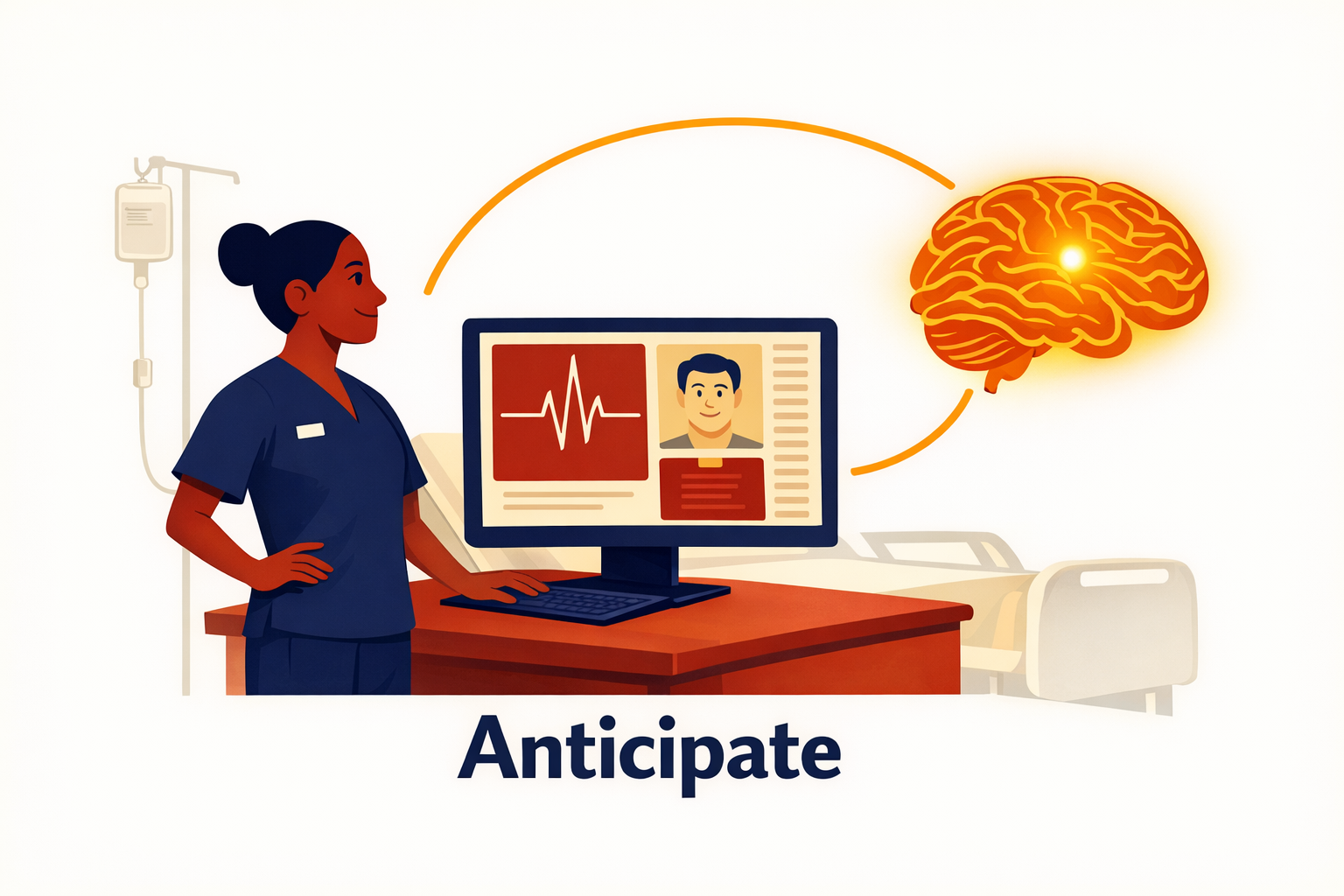
That’s what Anticipate means in the Connected Care Room. The Connected Care Room is a capability model built around five functions: Monitor, Anticipate, Connect, Personalise, and Orchestrate. Together they describe what a patient room must do to enable proactive, coordinated care. Anticipate is the capability that turns monitoring data into forward-looking signal: surfacing what is likely to happen next across patient condition, patient needs, and care process, before issues escalate, complaints are filed, or teams are forced into last-minute firefighting.
Monitoring gives the room its senses. Anticipate is what happens when those senses are connected to a brain.
The Signal Problem
Anticipation in healthcare is not a new idea. Early warning scores, fall risk assessments, and discharge planning processes all exist to help teams act before problems worsen. The challenge is not the intent. It is the calibration.
Prediction systems live or die on their signal quality. Raise too many false positives and the signal disappears into noise. Alert a nurse to a potential deterioration event that doesn’t materialise, then do it again, and again, and what you’ve built is not an anticipation capability. You’ve built a new source of interruption that gets tuned out.
A cross-sectional survey of nearly 4,000 registered nurses across 213 acute care hospitals in New York and Illinois found that 83% reported feeling overwhelmed by alarms, and 55% had experienced situations where a patient needed urgent attention, but no one responded (1). Critically, nurses on medical-surgical units reported these experiences at significantly higher rates than those in intensive care units. A separate study of over 2,000 US nurses found that those who routinely experience alarm overwhelm have nearly two and a half times the risk of severe burnout (2). Alarm fatigue is not a peripheral concern. It is eroding both patient safety and the wellbeing of the nurses meant to respond.
The opposite failure is just as damaging. Too many false negatives causes trust to collapse quietly. A system that misses the events that matter leaves nurses worse off than before: they’ve learned to discount the technology and fallen back on their own vigilance instead.
The standard for anticipation is therefore not prediction, but credible prediction. Signal, not noise, not silence.
Patient Condition
Most early warning scores used on general units today are calculated from intermittent vital sign readings and summarised into a single number. The problem is not the concept; it’s the currency of the data. A score calculated from observations taken hours apart cannot detect a patient who is quietly trending toward deterioration between checks. By the time the score reflects the risk, the opportunity for early intervention may already have narrowed.
This is compounded by the calibration problem. Traditional early warning scores generate significant numbers of alerts for patients who do not deteriorate and miss meaningful proportions of those who do. The result is exactly the signal problem described above: teams learn to treat the score as background noise rather than actionable intelligence.
More sophisticated approaches are beginning to change this. Kaiser Permanente Northern California developed the Advance Alert Monitor, a predictive analytics programme that continuously analyses EHR data across medical, surgical, and telemetry units to identify patients at risk of deterioration up to twelve hours in advance. Rather than alerting bedside nurses directly, alerts are reviewed by a centralised team of virtual quality nurse consultants who cascade validated, actionable information to the care team. A study published in the New England Journal of Medicine evaluating deployment across 19 hospitals found statistically significant reductions in mortality, ICU admissions, and hospital length of stay. The programme is estimated to have prevented more than 500 deaths per year across the Kaiser Permanente system (3).
The care model matters as much as the algorithm. The AAM model works not just because the prediction is sophisticated, but because the response architecture is. Alerts are curated by trained nurses before they reach the bedside, which means the signal arriving at the unit is already filtered and validated. This is AI-augmented care in practice: the algorithm identifies risk, and humans decide what to do with it.
There is a further dimension emerging. These predictive models draw primarily on EHR data: labs, vitals, medications, documentation. That is useful, but it is incomplete. It captures what has been recorded, not what is happening in the room between recordings. Computer vision is beginning to change that. At Humanitas Gavazzeni Hospital in Bergamo, ceiling-mounted cameras using anonymised image processing monitored patient movement continuously and alerted nurses in real time when risky situations were detected. A study published in 2025 found that patients monitored by the system had a 79% lower incidence of falls compared to those without it (4). The clinical significance extends beyond falls: the same approach can detect early signs of distress (5), pain (6), and delirium (7), conditions that fluctuate throughout the day in ways that scheduled observation consistently misses. None of these are reliably visible in a chart. The more continuous and contextually rich the monitoring layer becomes, the more accurate anticipation can be. Computer vision doesn’t replace EHR-based prediction. It gives those models something closer to the full picture.
Patient Needs
The anticipation gap for patient needs is different in character. It is not a noise problem. It is a silence problem.
Between nurse interactions on a typical med-surg unit, the room generates almost no forward-looking signal about what a patient might need next. A patient who has been awake since 2am, anxious about a procedure they don’t fully understand is not visible to the care team until they reach for the call bell. At that point, the need has already escalated to interruption. The nurse responds, but the window for earlier, lower-cost action has closed.
Proactive rounding exists precisely to address this, and evidence consistently supports its value. A systematic review found that structured intentional rounding reduced call bell use and was associated with reductions in patient falls ranging from 24 to 80 percent across included studies (8). But rounding on a schedule is still a blunt instrument. It doesn’t distinguish between the patient who is settled and the one who is building toward a need.
Anticipation in this domain starts with something more achievable than it might sound: giving care teams earlier, more contextual awareness of which patients are likely to need attention, and why. Not through prediction models that don’t yet exist at scale, but through smarter use of what the room already knows. How long since the last interaction. Whether a patient has been awake overnight. Whether questions have been logged but not yet resolved. Whether pain or anxiety has been documented and not followed up.
That contextual awareness, surfaced at the right moment to the right person, is enough to shift rounding from time-driven to need-driven. It doesn’t require perfect prediction. It requires the room to stop being silent between interactions and start holding context that the care team can act on. This is where Monitor and Anticipate connect directly: the more context the room holds, the less the care team has to rely on being there to know what’s happening.
Care Process
Discharge planning is where the anticipation failure in care processes is most visible and most costly.
In most hospitals, formal discharge planning begins when a patient is already close to clinical readiness. At that point, the barriers to safe discharge, coordinating home care, arranging transport, completing patient education, confirming a destination bed, become urgent rather than planned. Length of stay extends not because the patient isn’t ready, but because the system wasn’t anticipating their readiness early enough to get ahead of it.
This is a solvable problem. A growing body of research demonstrates that machine learning models applied to EHR data can predict discharge timing, likely discharge destination, and potential barriers significantly earlier than current practice allows. A study drawing on EHR data from Oxford University Hospitals achieved strong accuracy in predicting individual patient discharges in the next 24 hours, outperforming simpler statistical approaches and demonstrating the potential of such models to support proactive bed and resource management (9).
Earlier prediction of discharge readiness changes what teams can do. Social work can be engaged before the situation is urgent, and patient education can be paced across the admission rather than compressed into the final hours. Families can be prepared while transport and destination arrangements can be made when there is still time to course-correct if they fall through. But anticipation is only the first step. Each of those actions involves different people, different systems, and different timelines. Ensuring the right person takes the right action at the right time is a question of connection and orchestration, the two capabilities this series turns to next.
From Awareness to Foresight
The through line across all three domains is the same. Anticipation only works when it is calibrated well enough to be trusted. Too much noise and teams disengage. Too much silence and they are left flying blind. The goal is a system that earns trust by being right often enough to act on, and honest enough about uncertainty to stay credible over time.
Monitoring gives the room its senses. Anticipation puts them to use. When those two capabilities work together, care teams can stop absorbing risk and start acting on it.
https://bmjopenquality.bmj.com/content/12/4/e002342
https://www.nursingoutlook.org/article/S0029-6554(24)00181-7/abstract
https://pubmed.ncbi.nlm.nih.gov/35902140/
https://pubmed.ncbi.nlm.nih.gov/40309322/
https://pubmed.ncbi.nlm.nih.gov/33835095/
https://www.jmir.org/2024/1/e51250/
https://www.mdpi.com/2313-433X/10/10/253
https://onlinelibrary.wiley.com/doi/10.1111/inr.12984
https://www.nature.com/articles/s43856-024-00673-x