Over the past year, I’ve attended healthcare conferences across multiple markets, and one thing has become impossible to miss: nearly every conversation in healthcare has become a conversation about AI.
Across keynotes, panels, and hallway discussions, the narrative is consistent.
Healthcare providers are being presented with new AI-powered solutions. Technology vendors are doubling down on large language models. Investors expect every company to have an AI strategy.
But after a year of conversations with healthcare leaders around the world, I’ve come to believe we’re starting in the wrong place.
Healthcare doesn’t have an AI problem. It has a healthcare capacity problem.
The Real Challenge Facing Healthcare Systems
To understand where AI can truly add value, we need to focus first on the problem it’s meant to solve.
The World Health Organization has warned of a significant global shortage of nurses by 2030. At the same time, healthcare systems, particularly in the United States, are facing rising demand driven by aging populations, more complex patient needs, and higher expectations around care delivery.
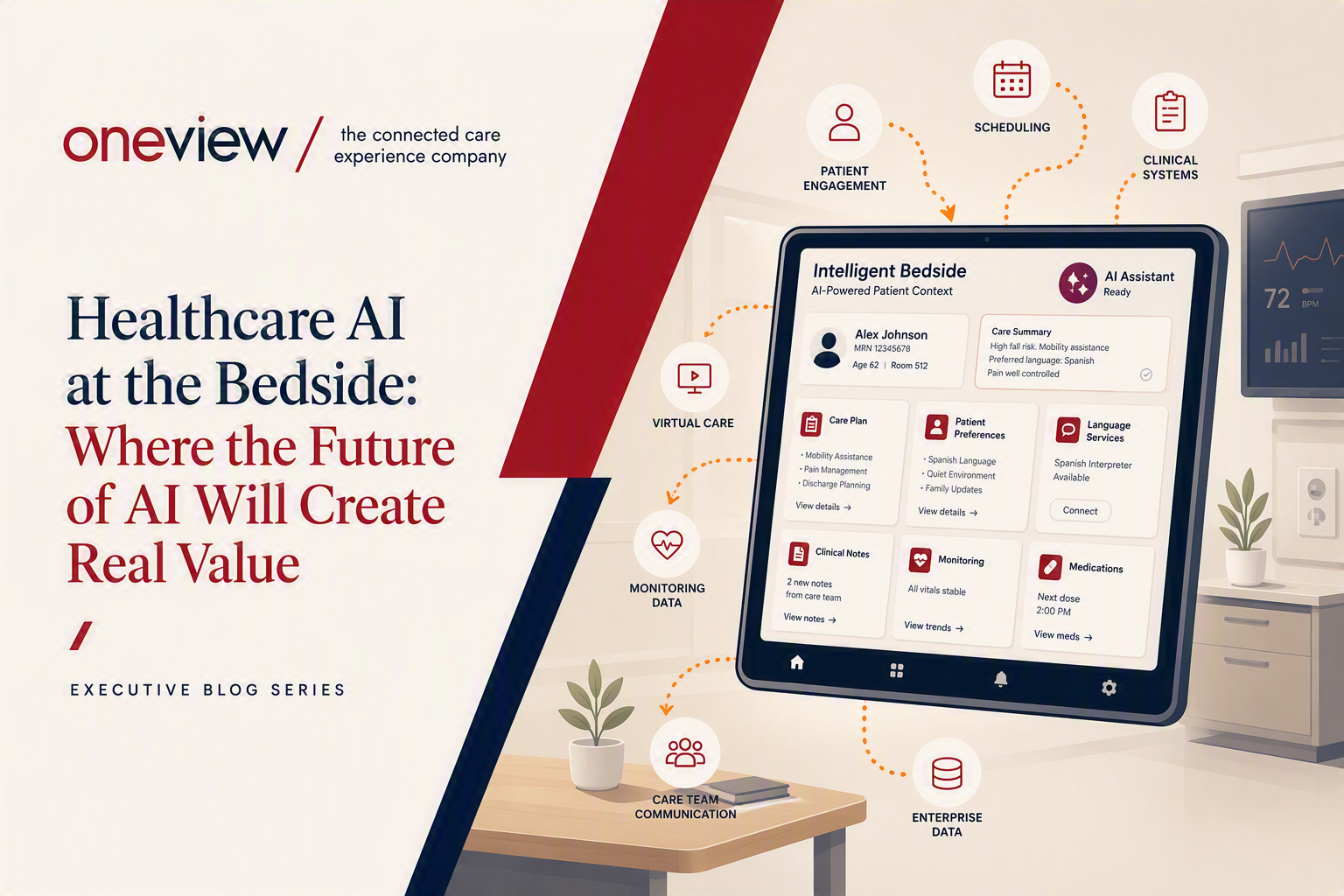
In practical terms, that might mean reducing routine bedside requests, making discharge communication easier, or surfacing the right information to the right caregiver at the right moment.
The equation is simple:
Demand for care is growing faster than healthcare systems can expand capacity.
And that’s the issue keeping hospital leaders awake at night – not whether they have an AI strategy, but whether they can meet demand.
- Can we admit more patients?
- Can we discharge them more efficiently?
- Can we reduce clinician burnout?
- Can we help caregivers spend more time with patients?
These are the questions that matter.
From Technology Conversations to Time Conversations
One of the most notable shifts I’ve seen over the past year is how healthcare leaders talk about technology.
The conversation is no longer centered on features or models, it’s centered on time.
Every minute a nurse spends answering routine requests, chasing down information, documenting activities, or navigating fragmented systems is a minute taken away from patient care.
And time, in healthcare, is capacity.
This is where AI has its greatest opportunity – not as a replacement for clinicians, but as a force multiplier for them.
- Not to automate compassion
- But to create more time for it
- Not to replace expertise
- But to extend its reach
Creating Capacity, Not Just Deploying AI
Looking ahead, the most successful healthcare organizations won’t be those that simply deploy the most AI.
They will be the ones that use technology to unlock the most capacity.
That means focusing on:
- Reducing operational friction across care settings
- Simplifying workflows for overburdened staff
- Eliminating repetitive tasks that don’t require clinical expertise
- Enabling clinicians to work at the top of their license
These are not abstract goals. They are measurable, operational improvements that directly impact patient outcomes, staff satisfaction, and financial performance.
Trust Still Matters
Healthcare has always been a trust-driven industry—and rightly so.
Any new technology, including AI, must meet a high bar before it can be adopted at scale. That includes:
- Strong data security and governance
- Clear clinical validation
- Proven, measurable outcomes
- Transparent return on investment
The encouraging shift is that healthcare leaders are now asking more grounded, practical questions:
- How much time will this save?
- How will this improve workflows?
- What outcomes can it deliver?
- What is the ROI?
These are the questions that move the conversation from hype to impact.
Reframing the Role of AI in Healthcare
AI is one of the most significant technological advancements we’ve seen in healthcare in decades. Its potential is real – and transformative.
But we must be careful not to confuse the solution with the problem.
The problem is not a lack of artificial intelligence.
The problem is a lack of capacity.
If AI can help restore capacity by giving clinicians time back, streamlining processes, and improving the delivery of care,its impact will be profound.
Not because it replaces the human touch.
But because it creates more opportunity for it.