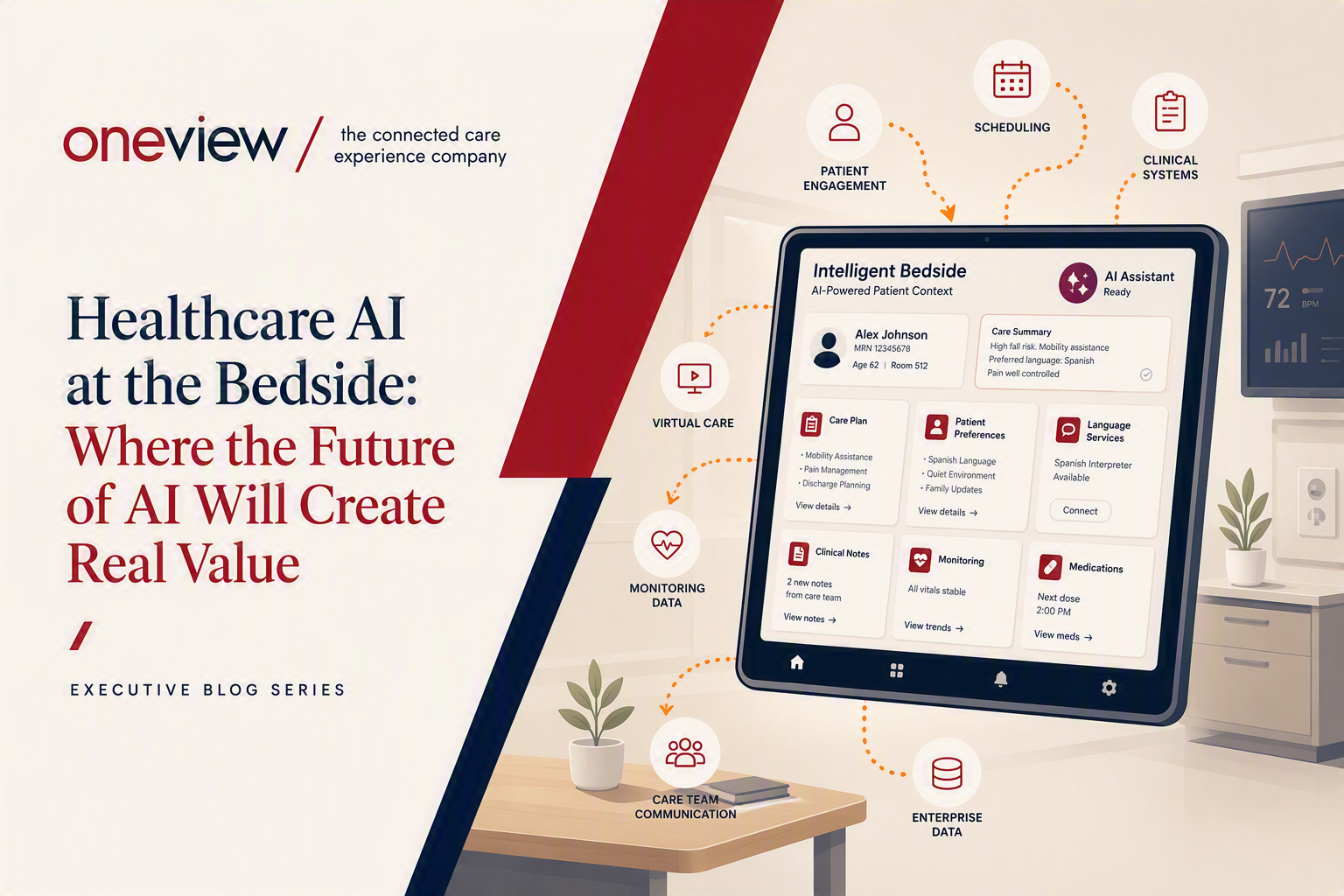
We explored how the Connected Care Room builds awareness (Monitor), turns that awareness into foresight (Anticipate), routes work to the right person at the right time (Orchestration), and connects patients, families, and care teams through shared real-time context (Connectivitiy). Together, those capabilities help care become more proactive, coordinated, and sustainable. The fifth capability addresses a different challenge: ensuring that care feels personal to the individual receiving it.
A good nurse personalizes care instinctively. They lower the lights for the patient who is overwhelmed, find the words that land for the family who is frightened, adjust how they explain a diagnosis depending on who is in front of them. Personalization is one of the most human things that happens in a hospital. It is also one of the least scalable.
Modern hospitals are caring for increasingly diverse patient populations while operating under persistent workforce constraints. Patients arrive with different languages, abilities, preferences, health literacy levels, and support networks. Delivering a personalized patient experience in every interaction is difficult when personalization depends entirely on the memory, availability, and bandwidth of busy clinicians.
This is where the fifth capability of the Connected Care Room comes in.
Why Personalized Patient Care Is Difficult to Scale
Personalized patient care is not a new idea. Healthcare has always aspired to treat patients as individuals rather than diagnoses. The challenge is that much of today’s personalization still depends on people rather than systems.
Being admitted to hospital means surrendering control. Patients lose control over when they eat, when they sleep, when they are woken, and who enters the room. That loss breeds dependency on nursing staff, and it carries a measurable cost.
Anxiety is the visible form of that cost. In a study of 500 patients admitted with a heart attack, anxiety was an independent predictor of in-hospital complications, and patients with a high sense of perceived control had markedly lower anxiety. This was a single-country, observational study, so it shows association rather than cause. But the mechanism is plausible and the association is real, and it is consistent with what nurses see every day.
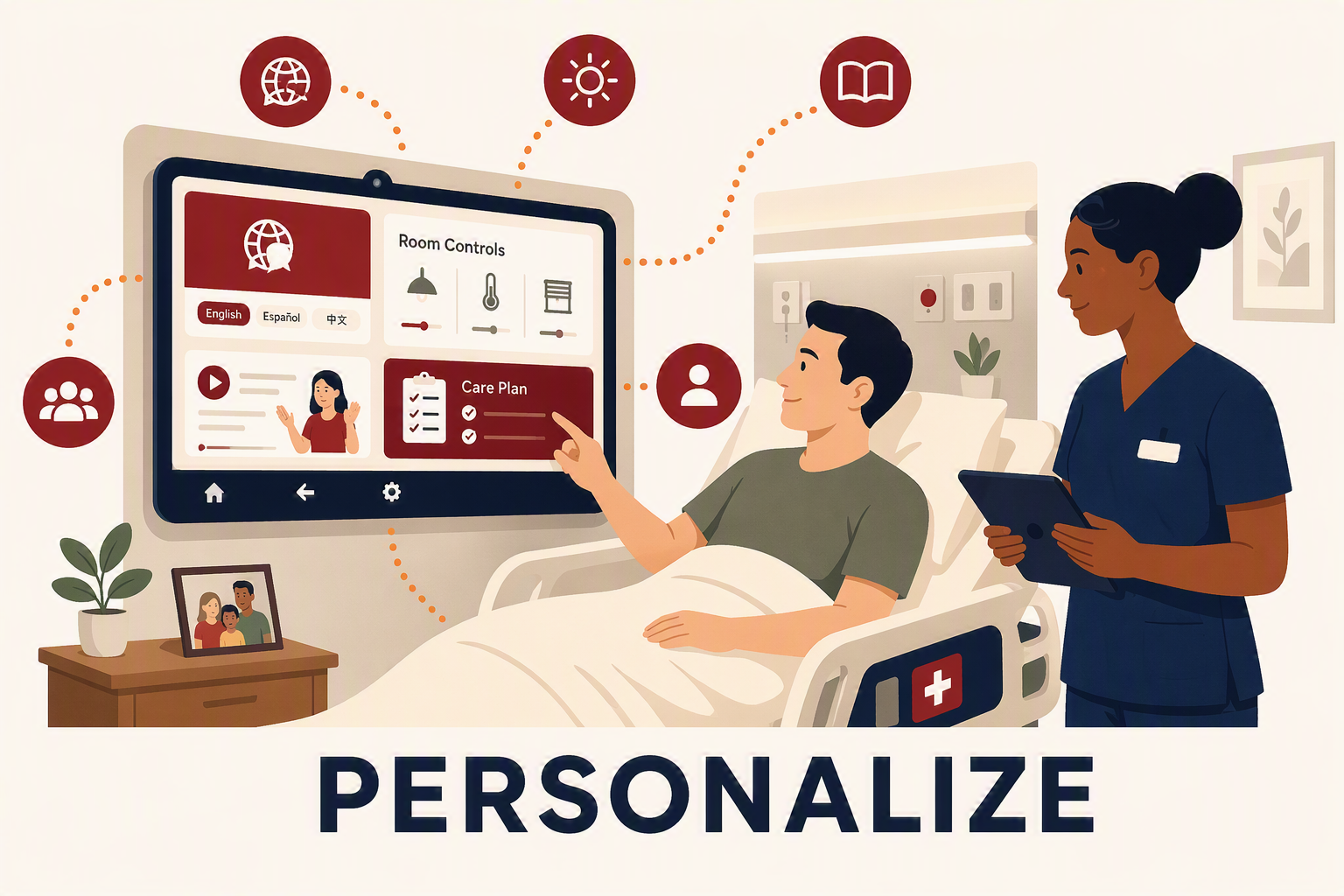
The environment is one of the most direct levers for restoring that control. A study of hospitalized older adults found that those who experienced their environment as supportive rather than controlling reported greater need satisfaction, more positive mood, and less apathy and boredom. Giving a patient command of their own surroundings, the lighting, the temperature, the blinds, the entertainment, returns a measure of autonomy to a person who has had most of it taken away. It also frees the bedside nurse from being summoned for things the patient can control themselves.
Information In The Patient’s Own Language
A patient cannot participate in their own recovery without understanding what is happening to them or what they must do to go home. For patients who do not speak the dominant language of the hospital, that gap is not an inconvenience. It is a safety problem.
The evidence is unambiguous. In a study of more than 1,600 parents across seven North American hospitals, children whose parents were not comfortable communicating in English had roughly twice the odds of experiencing an adverse event during admission. A systematic review of 33 studies reached the complementary conclusion: when patients receive care in a language they understand, outcomes improve across most measures studied.
Personalise means delivering each patient the information that matters to them, about their condition, their plan, and what they need to achieve to be discharge-ready, in the language they actually understand. Not a translated leaflet handed over once on admission, but continuous, plain-language information about where they are in their stay and what comes next, on demand. The bedside nurse cannot hold a fluent conversation in every language spoken on the unit. A system can.
Engagement That Meets The Patient Where They Are
How a patient should be taught depends on who they are. A frightened seventeen-year-old, a recovering stroke patient relearning daily tasks, and an eighty-year-old with three chronic conditions do not learn the same way. Age, health literacy, and learning style all change what good engagement looks like.
The bedside nurse is not well positioned to calibrate this for every patient. An integrative review found that nurses consistently overestimate how much patients understand, which leads to education pitched too high that quietly fails. This is not a criticism of nurses. It reflects how hard it is to adapt to each individual while carrying a full patient load. When teaching is tailored, it works. A pilot study of inpatients found that combining written instructions with verbal teaching and the teach-back method significantly improved understanding across every domain of the discharge plan, with the largest gains among patients who had less formal education. The intervention helped most exactly the people most often left behind.
Tailoring this by hand does not scale on the bedside nurse alone. With technology, and with virtual nursing capacity working alongside the bedside team, it can. A system that knows a patient’s age, language, and learning needs can adapt how it presents information, and a virtual nurse, where roles are clearly defined as the Orchestrate post set out, can spend the unhurried time on education that the bedside nurse rarely has.
A Room That Adapts To The Patient
The technology in the room has to meet the patient, not the other way around.
An interactive television or bedside tablet is only useful if the patient can actually use it. For an older patient with declining eyesight, that means adjustable text and a simple interface. For a patient with limited dexterity, controls they can operate.
When the room adapts, it earns its place in personalized care. A randomised trial of 426 patients found that those given a bedside tablet connected to an inpatient portal had a lower thirty-day readmission rate than those who received usual care or a tablet without the portal. A qualitative study of smart hospital rooms in a rehabilitation setting described the wider opportunity: rooms where patients control the entertainment and environment digitally, and where education adapts to each patient’s changed abilities. That work is early and design-focused rather than a measured outcome, but it points clearly at what a personalized room can be.
Nowhere is this clearer than in pediatrics. The point is not how the room looks but whether it adapts to the child. Does the interactive television or whiteboard present a child’s experience rather than a clinical one, and can the child shape their own surroundings? At University of Iowa Stead Family Children’s Hospital, each room has a colored light the child can control, a small piece of the environment that is theirs.
Personalize Makes Shared Care Personal
Shared information only creates value if it is meaningful to the person receiving it. The same update may need to be communicated differently to a physician, a bedside nurse, a family caregiver, or a patient.
That is the thread running through all five capabilities. None of them is really about the technology. They are about restoring to inpatient care the things that get lost at scale: attention, foresight, coordination, connection, and now the human act of treating each patient as an individual. The capabilities exist so the system can extend the reach of the best nurses to every patient, in every room, at every hour, rather than leaving it to depend on whether the right person happens to be at the bedside at the right moment.
A truly connected care environment should not simply connect everyone to the same information. It should help each person understand, participate in, and act on that information within the context of their role and needs.
That is what turns connected care into patient-centered care.
The Through Line
Across all five capabilities, the common theme remains the same: reducing the burden of manual coordination while improving the experience of care.
Taken together, these capabilities describe a future where technology supports care without making care feel technological. Because the goal of a Connected Care Room is not to create a smarter room, it is to create a more human healthcare experience.
The harder question every leader reading this is already asking: how do you actually get there? Moving from a collection of disconnected point solutions to a room that monitors, anticipates, orchestrates, connects, and personalizes as one is a question about platforms, not features. In the next post I will step back from the capabilities and share how Oneview and our partners can help you realize the Connected Care Room.
References
Aburuz ME. Perceived control moderates the relationship between anxiety and in-hospital complications after ST segment elevation myocardial infarction. Journal of Multidisciplinary Healthcare. 2018;11:359-365. https://doi.org/10.2147/JMDH.S170326
Souesme G, Martinent G, Akour D, Giraudeau C, Ferrand C. Causality Orientations and Supportive/Controlled Environment: Understanding Their Influence on Basic Needs, Motivation for Health and Emotions in French Hospitalized Older Adults. Frontiers in Psychology. 2020;11:575489. https://doi.org/10.3389/fpsyg.2020.575489
Khan A, Yin HS, Brach C, et al. Association Between Parent Comfort With English and Adverse Events Among Hospitalized Children. JAMA Pediatrics. 2020;174(12):e203215. https://doi.org/10.1001/jamapediatrics.2020.3215
Diamond L, Izquierdo K, Canfield D, Matsoukas K, Gany F. A Systematic Review of the Impact of Patient-Physician Non-English Language Concordance on Quality of Care and Outcomes. Journal of General Internal Medicine. 2019;34(8):1591-1606. https://doi.org/10.1007/s11606-019-04847-5
Hogan AE, Hughes L, Coyne E. Nurses’ assessment of health literacy requirements for adult inpatients: An integrative review. Health Promotion Journal of Australia. 2023;34(2):348-357. https://doi.org/10.1002/hpja.780
Parikh PD, Jaisinghani P, Kaloth S, Konakanchi A, Yanamala N, Kim S. Enhancing Patient Understanding of Hospitalization and Post-Discharge Needs: The Impact of Physician-Led Verbal Communication and Teach-Back Method. Journal of General Internal Medicine. 2025. https://doi.org/10.1007/s11606-025-09510-w
Creber RMM, Grossman LV, Ryan B, et al. Engaging hospitalized patients with personalized health information: a randomized trial of an inpatient portal. Journal of the American Medical Informatics Association. 2019;26(2):115-123. https://doi.org/10.1093/jamia/ocy146
Dawson J, Phanich KJ, Wiese J. Reenvisioning Patient Education with Smart Hospital Patient Rooms. Proceedings of the ACM on Interactive, Mobile, Wearable and Ubiquitous Technologies. 2023;7(4):1-25. https://doi.org/10.1145/3631419 University of Iowa Stead Family Children’s Hospital. Patient Room Design. Accessed 16 June 2026. https://uihc.org/childrens/patient-room-design-university-iowa-stead-family-childrens-hospital