What Is Connectivity in a Connected Care Room?
In the earlier posts in this series, we explored how a Connected Care Room builds awareness (Monitor), turns that awareness into foresight (Anticipate), and routes work to the right person at the right time (Orchestrate).
But care is not only a set of tasks. It is a set of relationships—between patients, families, and care teams. Those relationships only work when people can participate in care together.
For most of the history of inpatient care, taking part in a patient’s care has meant being in the room. That constraint shaped everything about how hospitals coordinate. It is also the constraint that the fourth capability of the Connected Care Room sets out to remove.
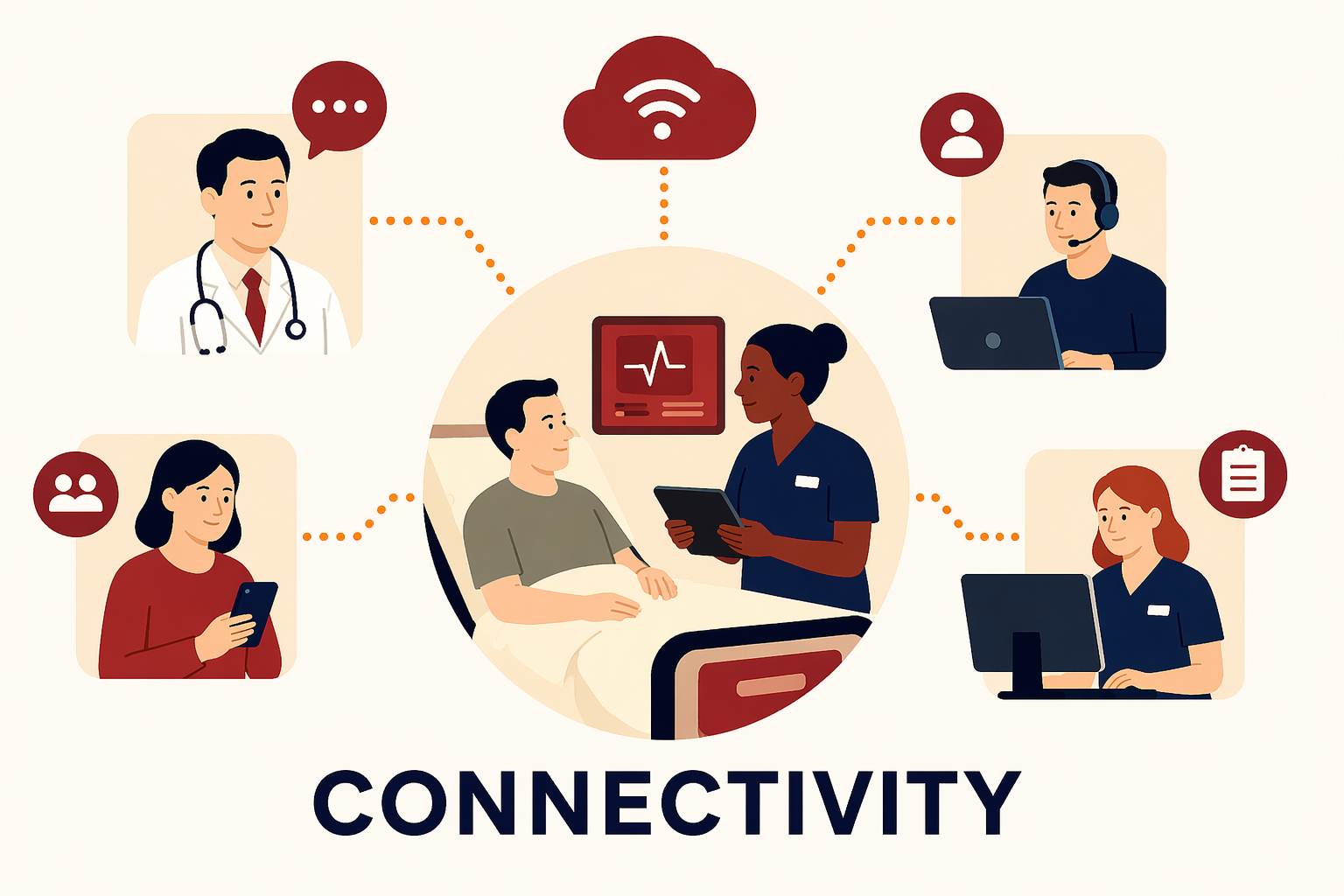
Connected Care Room connectivity is the ability to bring patients, families, and care teams into a shared, real-time picture of care, regardless of where they are physically located.
Why Participation Used to Require Presence
For most of the history of inpatient care, participation meant being in the room.
That constraint still shapes how hospitals coordinate today. It also creates a familiar pattern: the bedside nurse becomes the conduit for everyone else.
Consider a typical admission. A consultant rounds early in the morning. A daughter who manages medications works a shift that ends hours later. A virtual nurse sits in a remote hub. The bedside nurse is the only person reliably present.
So information flows through that nurse – not because it is the best model, but because it is the only one.
When participation depends on presence, the people who cannot be present are excluded by default. That includes the family members who carry the most context about the patient, and the remote clinicians who could contribute the most.
Enabling Remote Participation in Hospital Care
Connected Care Room connectivity changes the unit of participation from “who is present” to “who is needed.”
At its simplest, this happens through:
- On-demand video in the patient room
- Real-time access to shared information
A remote family member can join the physician round in real time, hear the plan as it is formed, and ask the question that only they would think to ask. Family participation in rounds is not a soft benefit. A 2023 systematic review synthesizing sixty-seven studies across pediatric and adult care, found that involving families in rounds consistently improved communication, situational understanding of the care plan, and the relationship between families and care teams.
The difficulty has always been getting them there. Video closes that gap. In a US study of virtual family-centered rounds in a pediatric intensive care unit,every family reported that it improved their understanding of their child’s condition and most clinicians felt it improved communication while it did not lengthen the round. The study was single-site and based on satisfaction measures, but the mechanism it describes is the one that matters here. Video removes distance as a barrier to participation.
Virtual Nursing and Remote Care Team Collaboration
The same shift applies to the care team. A 2025 observational study at the University of North Carolina found that virtual nurses completed 80.2 percent of admission documentation, compared with 58.8 percent by bedside nurses. A 2025 survey of hospital nurses, published in JAMA Network Open, found admission and discharge activities among the most common uses of virtual nursing in practice. None of this is possible if participation requires presence. All of it becomes possible when the room can connect a remote clinician to the patient as if they were standing there.
Why the Hospital Whiteboard Was Never Enough
Bringing people together is only half of connectivity. The other half is making sure they are working from the same information.
For decades, the primary tool for that job has been the whiteboard on the wall of the patient room. It was meant to close information gaps: to show the patient, the family, and the care team the same plan of care, the same expected discharge date, the same names of the people responsible. It was a good concept, but the mechanism was not.
A whiteboard depends entirely on someone remembering to update it. A board is only as current as the last person who picked up the marker. A 2025 scoping review in the Journal of General Internal Medicine examined bedside whiteboards across thirteen studies and found that, despite their being ubiquitous and low-cost fixtures, their measurable impact on patient communication was inconsistent, with only some studies showing significant improvement, and their impact on safety and education barely studied at all. The concept behind the whiteboard makes sense, but the manual mechanism behind it is the weak point.
The room should hold the shared truth, not rely on memory.
Replacing Static Information with Shared, Real-Time Context
Connected Care Room Connectivity keeps the whiteboard’s purpose and replaces its mechanism. A digital whiteboard, integrated with the electronic health record updates itself. The plan of care is not a snapshot someone remembered to write down. It is a live view of what the system already knows.
That shared, automatically maintained context is what makes remote participation coherent rather than chaotic. The virtual nurse and the bedside nurse work from the same picture. The family member joining the round sees the same plan the consultant is discussing. It also gives discharge a foundation to run on, instead of a set of tasks assembled from memory under pressure. A 2024 scoping review of more than 700 studies found that the primary driver of delayed discharge is inadequate internal coordination, not bed capacity, and a 2025 review found that structured discharge coordination reduced length of stay by half a day to a full day. Shared context does not produce those gains on its own. It is the foundation that coordination runs on. When everyone sees the same live picture, the coordination that drives those outcomes has something reliable to build on, and fewer things fall through the gaps between people.
The Impact of Connectivity on Care Coordination
Monitor gives the room senses. Anticipate looks ahead. Orchestrate routes the work. Connectivity dissolves the two old constraints that kept people on the outside of care: the assumption that you had to be present to participate, and the reliance on someone manually keeping the shared record current. Video brings the absent into the room. An integrated digital whiteboard keeps everyone working from the same live truth.
Connect ensures everyone can act together, from the same understanding.
What Comes Next: Personalise
Connectivity ensures that everyone involved in care can see the same picture.
But the same picture, delivered in the same way to every patient, is not yet a personal experience.
The final capability in this series, Personalise, explores how that shared context becomes care that adapts to the needs, preferences, and circumstances of each individual patient.
References
Woldring JM, Luttik ML, Paans W, Gans ROB. The added value of family-centered rounds in the hospital setting: A systematic review of systematic reviews. PLOS ONE. 2023;18(1):e0280142. https://doi.org/10.1371/journal.pone.0280142
Solt SA, Stolfi D, Ritter VS, Kihlstrom M. An Apple iPad a Day Brings the Doctor to You: Virtual Family-Centered Rounds in a Pediatric Intensive Care Unit. Journal of Pediatric Intensive Care. 2024;13(4):330-336. https://doi.org/10.1055/s-0042-1742673
Gregg AT, Herzig SJ, Nelson RE. Whiteboards to Facilitate Hospitalized Patient Communication, Safety, and Education: A Scoping Review. Journal of General Internal Medicine. 2025;40(6):1411-1418. https://doi.org/10.1007/s11606-025-09419-4
Kenan-Flagler Business School, University of North Carolina. Solving a Shortage With Virtual Nurses. 2025. https://www.kenan-flagler.unc.edu/news/solving-a-shortage-with-virtual-nurses/
Muir KJ, Maye A, McHugh MD, Aiken LH, Vo V, Lasater KB. Virtual Nursing for the Care of Hospitalized Patients. JAMA Network Open. 2025;8(12):e2545597. https://doi.org/10.1001/jamanetworkopen.2025.45597
Abdelhalim A, Zargoush M, Archer N, Roham M. Decoding the persistence of delayed hospital discharge: An in-depth scoping review and insights from two decades. Health Expectations. 2024;27(2):e14050. https://doi.org/10.1111/hex.14050